
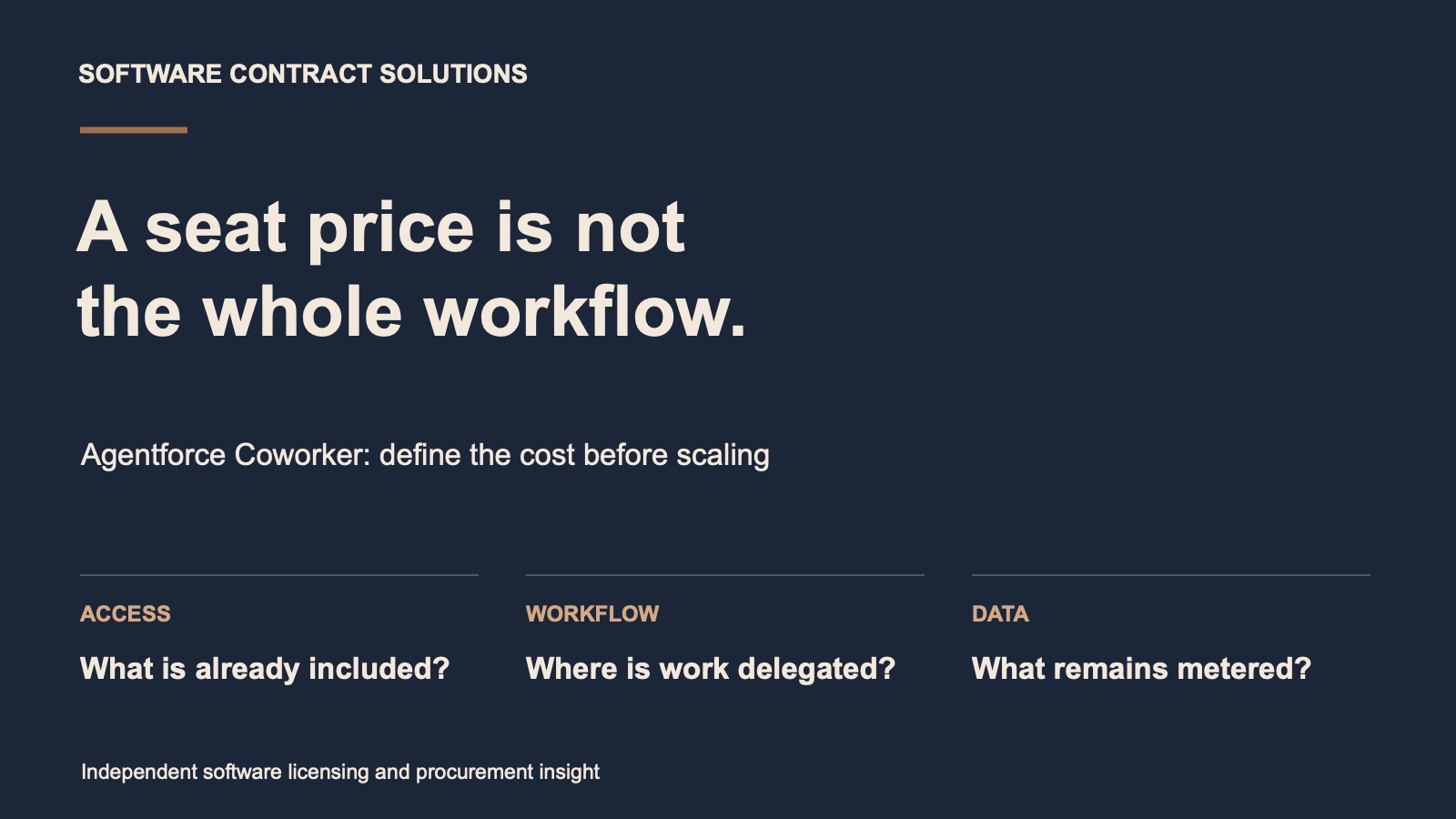
Choose Agentforce Coworker seats or credits by the work users will perform, the access they already hold and the charges that remain outside that access. A predictable per-user price can be useful. It does not, by itself, establish the total cost of a workflow that delegates work to other agents or processes additional data.
Salesforce’s November 4, 2026 announcement expanded Coworker and highlighted a standalone per-user offer. For CIOs and procurement leaders, the next step is to translate the product announcement into a buying specification that finance and administrators can both verify.
Start with the exact license, not the familiar product name
The current US pricing page lists the Agentforce Coworker User License at $50 per user per month. It separately lists an Agentforce User License at $5 per user per month that requires Flex Credits. Those are different offers. The lower access price is not a substitute for the Coworker seat’s included scope.
Salesforce’s billing documentation says certain Agentforce licenses already include unmetered Coworker access for authenticated, permitted users. Check existing entitlements before adding another line to the order. Also identify the user population, edition, ordering route and contracted conditions that apply to your organization.
Group users by a demonstrated workload. A frequent user with repeatable tasks and an occasional user exploring a pilot should not automatically produce the same purchasing decision. Ask the business owner what will be used now, what depends on integration work, and what evidence supports expansion.
Separate included access from delegated work
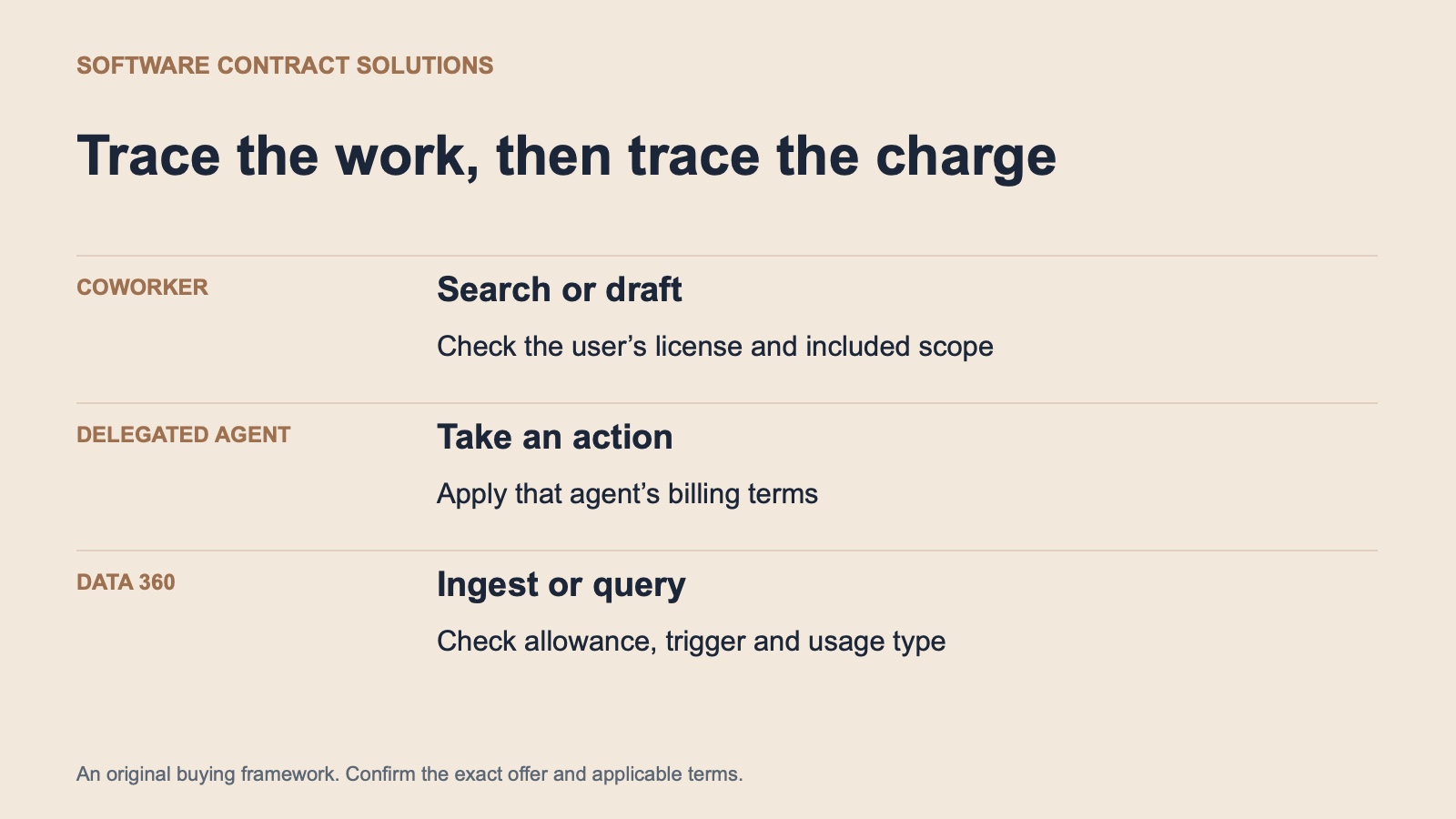
A user can begin a task in Coworker without every subsequent step sharing the same billing treatment. Salesforce distinguishes included seat-based queries from work delegated to another agent. Delegation follows that agent’s terms, including when the user has a Coworker seat.
Map the entire workflow before estimating cost. For example, a hypothetical account team might search records, draft a response and then ask another agent to perform an action. The buying review should identify which stage uses Coworker, which stage invokes another service and which configured access or approval makes that action possible. This is a planning example, not a claim about a particular organization’s configuration.
| Cost layer | Question for the buying team |
|---|---|
| User access | Which existing or proposed license covers each user? |
| Coworker activity | Which activity is included for that license, and which is metered? |
| Delegated actions | Which agent performs the work and under what terms? |
| Connected data | What ingestion, indexing or querying remains chargeable? |
| Implementation | What work is needed before the expected use can occur? |
Put Data 360 in the forecast
The documented Coworker seat includes a monthly unstructured-data ingestion and indexing allowance of 30 MB per user, pooled across the organization; unused allowance does not roll over. Additional consumption may use credits. Data 360 queries triggered by a delegated agent can also have a different billing treatment from queries triggered by Coworker itself.
That makes the data plan a commercial input. Identify what content must be indexed, how much changes and who owns its refresh cycle. Separate an initial ingestion from recurring activity. Have the administrator validate the estimate against the applicable usage types and the organization’s actual configuration.
Use the November 3 Flex Credits rate card with the governing order details. It distinguishes usage types and production versus sandbox multipliers. A single “cost per prompt” assumption will not describe every combination of queries, actions and data processing.
Make the pilot capable of answering the purchase question
Agree on the evidence before the pilot expands: eligible users, actual recurring activity, completed business tasks, delegated services, data volumes and the operational work needed to keep the process running. Use a lower-adoption case as well as expected and higher-consumption cases.
A useful comparison shows seat charges and uncovered consumption once each. Do not add an included query charge to the seat scenario as though it were incremental. Do not omit a separate delegated-agent charge simply because the request started in Coworker. Compare the same workloads over the same period and document what changes when another team joins.
Salesforce’s Digital Wallet guidance explains another important limit: seat-included queries are not tracked as Flex Credit consumption, and related Data 360 usage can appear under its own usage type. A Coworker-only consumption report is therefore not the complete cost record.
Buy what is available and appropriate for your environment
The November announcement described scheduled tasks and Daily Digest as expected in December. Do not build the current purchase case around a roadmap feature without confirming that it is released and available for the required environment. The same check applies to region, edition and a public-sector purchasing route.
Before approval, have procurement obtain the exact offer, commitment period, included scope, treatment of additional usage and applicable documents. Have IT confirm the permitted access and configured controls. Name the person who can reconcile the forecast with actual charges and authorize expansion.
SCS SaaS Negotiations and Benchmarking can support the commercial comparison, while License Advisory Services can help establish the entitlement baseline. Request a free introductory consultation with the proposed offer and workflows you want it to support.